

2026-08-03 Posted by TideChem view:65
Methylated amino acids are amino acids or amino acid residues that contain one or more additional methyl groups. Depending on where the methyl group is attached, methylation can influence protein regulation, peptide conformation, enzymatic stability, membrane permeability, and molecular recognition.
The term covers several chemically distinct structures. These include side-chain-methylated residues such as methyllysine and methylarginine, backbone N-methyl amino acids, and α-methyl amino acids. Understanding these differences is essential when selecting research standards, designing modified peptides, developing analytical methods, or sourcing protected building blocks.
A methyl group consists of one carbon atom bonded to three hydrogen atoms and is written as CH₃. Amino acid methylation refers to the addition of this group at a specific position within an amino acid or an amino acid residue in a peptide or protein.
Methylated amino acids can arise naturally through enzymatic post-translational modification. They can also be prepared synthetically and incorporated into peptides to control conformation, improve stability, or investigate biological recognition.
The main categories are:
These categories should not be treated as interchangeable. The position of methylation determines the structure, biological function, synthetic route, and analytical requirements of the resulting molecule.
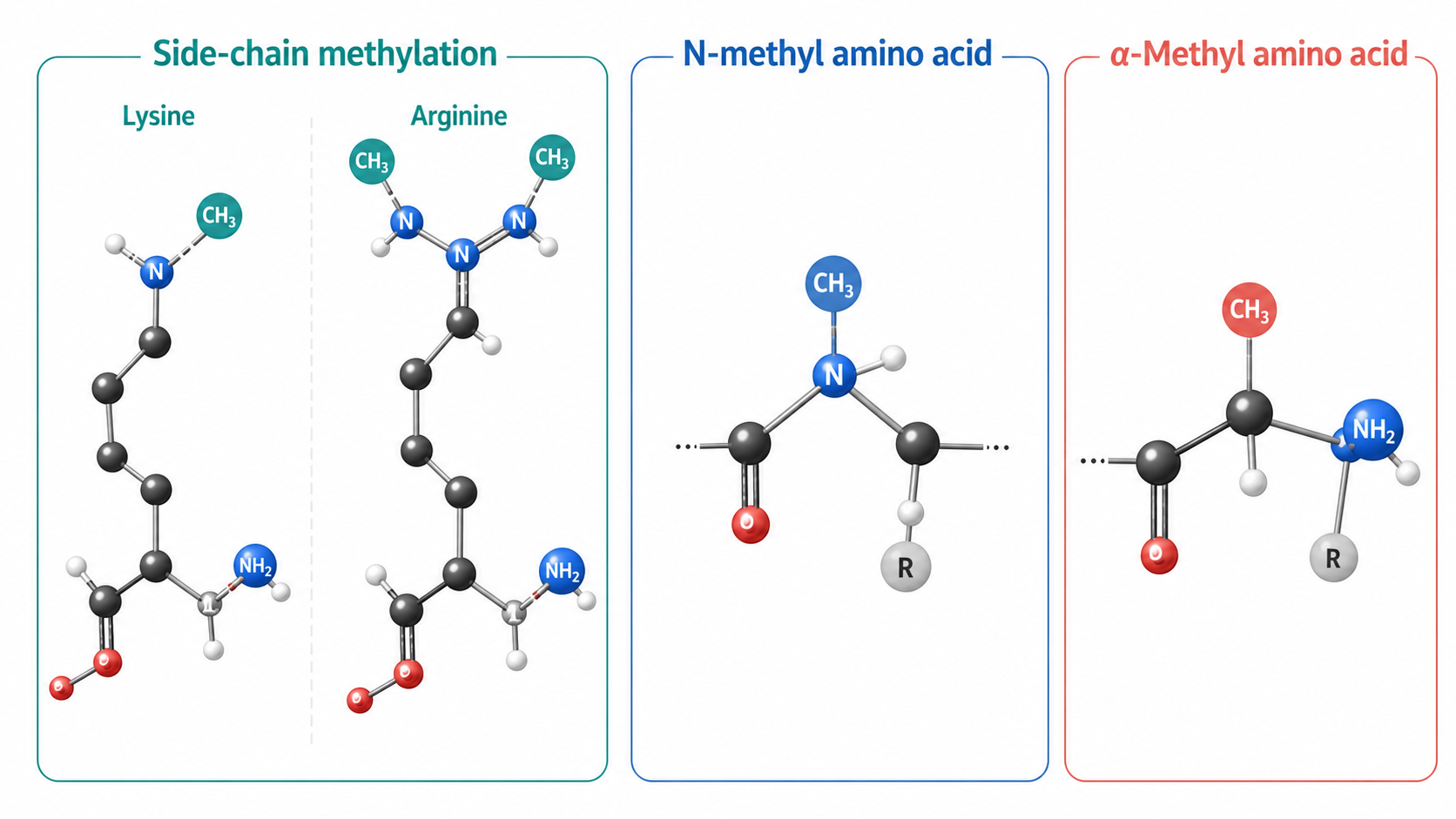
Major structural types of methylated amino acids
Lysine contains an ε-amino group at the end of its side chain. This nitrogen can carry one, two, or three methyl groups, producing:
The three methylation states are not simply different degrees of the same signal. Each creates a distinct molecular surface that can be recognized by different proteins.
Unlike lysine acetylation, methylation generally retains the positive charge of the lysine side chain. However, it changes steric volume, hydrophobicity, hydrogen-bonding behavior, and the way the residue interacts with reader proteins.
Lysine methylation is widely studied in histones, where it contributes to chromatin regulation. It also occurs in many non-histone proteins involved in transcription, DNA repair, metabolism, and signal transduction.
The biological effect depends on the modified residue and its methylation state. A methylated lysine cannot be classified as activating or repressive without knowing its position and molecular context.
Arginine methylation occurs on the guanidino group of the side chain. The major forms are:
Protein arginine methyltransferases, commonly called PRMTs, generate these different products. Arginine methylation is involved in RNA processing, transcription, DNA damage responses, protein localization, and the assembly of protein complexes.
The distinction between asymmetric and symmetric dimethylation is analytically important. Both forms have the same molecular mass, so precursor mass alone cannot distinguish them. Site-specific fragmentation, chromatography, reference standards, or other orthogonal methods may be required.
Histidine contains two nitrogen atoms in its imidazole ring. Methylation can occur at either position, producing N1-methylhistidine or N3-methylhistidine.
Protein histidine methylation is less extensively characterized than lysine or arginine methylation, but it is increasingly recognized as a regulated post-translational modification. Reported functions include cytoskeletal organization, translation, and cellular metabolism.
Because the two methylhistidine isomers have the same mass, determining the exact methylation position requires more than routine intact-mass analysis.
When an amino acid is incorporated into a peptide, its backbone nitrogen normally retains a hydrogen atom. In an N-methyl amino acid residue, this hydrogen is replaced by a methyl group.
Backbone N-methylation can:
N-methyl amino acids are frequently used in cyclic peptides and constrained peptide leads. They can help stabilize a bioactive conformation or mask exposed hydrogen-bond donors.
However, N-methylation is not universally beneficial. A poorly positioned methyl group may disrupt target binding, decrease aqueous solubility, create multiple conformers, or make synthesis more difficult. Its effects must be evaluated for each sequence.
An α-methyl amino acid contains an additional methyl group on the α-carbon. This is different from N-methylation, which occurs on nitrogen.
The additional substituent increases steric restriction around the peptide backbone. Depending on the residue and sequence, α-methyl amino acids may:
α-Methylation can introduce additional stereochemical complexity. Configuration, enantiomeric purity, and epimerization risk should therefore be considered during building-block selection and peptide synthesis.
N-methylation places a methyl group on nitrogen. α-Methylation places it on the α-carbon. These modifications affect peptide structure through different mechanisms.
A methyl ester is formed when the carboxyl group of an amino acid reacts with methanol or another methylating reagent. Methyl esters are often used as protecting groups, intermediates, or prodrug-related modifications.
A methyl ester should not be described as an N-methyl or side-chain-methylated amino acid.
Protein methylation modifies amino acid residues. DNA methylation modifies nucleobases, most commonly cytosine in specific sequence contexts. The enzymes, substrates, and biological consequences are different.
Most enzymatic protein methylation reactions use S-adenosyl-L-methionine, abbreviated as SAM or AdoMet, as the methyl donor.
A methyltransferase transfers a methyl group from SAM to a specific amino acid residue. S-adenosyl-L-homocysteine is formed as a reaction product.
Protein methylation systems are often described using three functional terms:
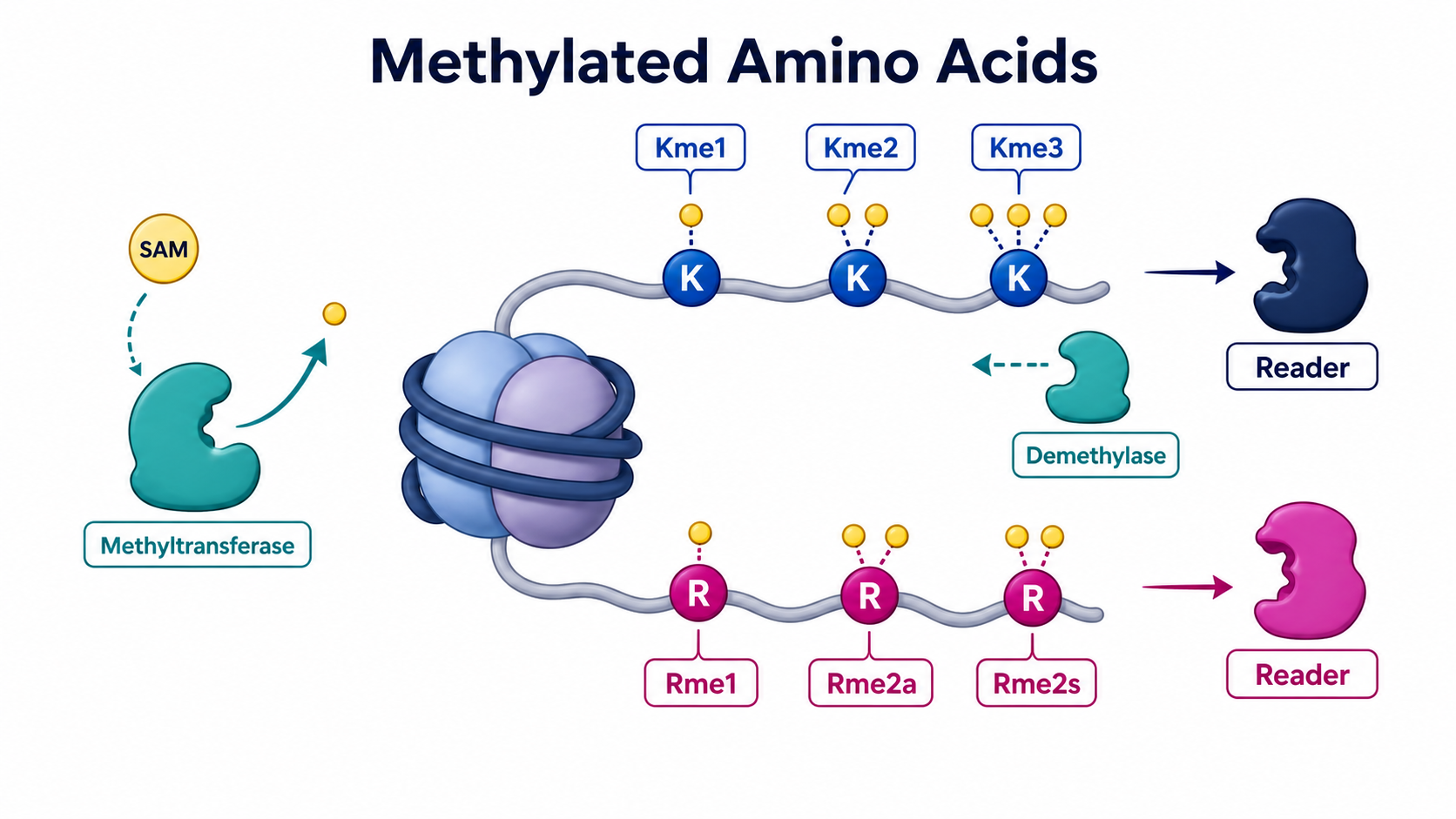
SAM-dependent methylation of lysine and arginine residues and recognition by reader proteins
This model is well established for many lysine modifications. Lysine demethylases can remove particular methylation states from defined substrates.
Arginine methylation is more complicated. Its biological reversibility and possible demethylation mechanisms remain less universally established, so arginine methyl marks should not automatically be described as reversible.
Histone proteins contain multiple lysine and arginine residues that can be methylated. These marks influence the recruitment of regulatory proteins and contribute to the organization of chromatin.
The effect is site-specific. Histone methylation may be associated with either transcriptional activation or repression depending on the residue, methylation state, surrounding modifications, and cellular context.
Methylation changes the molecular surface of an amino acid residue. Reader proteins can distinguish between unmethylated, monomethylated, dimethylated, and trimethylated states.
This enables cells to regulate protein-protein interactions without necessarily removing the positive charge of lysine or arginine.
Arginine methylation is common in RNA-binding proteins. It can influence RNA splicing, transport, translation, and the formation of ribonucleoprotein complexes.
Lysine and arginine methylation participate in the recruitment and regulation of DNA repair proteins. These modifications can influence protein localization, complex formation, and pathway selection.
Methylation is not limited to histones. Non-histone proteins involved in signaling, transcription, metabolism, and cytoskeletal organization may also contain regulated methylation sites.
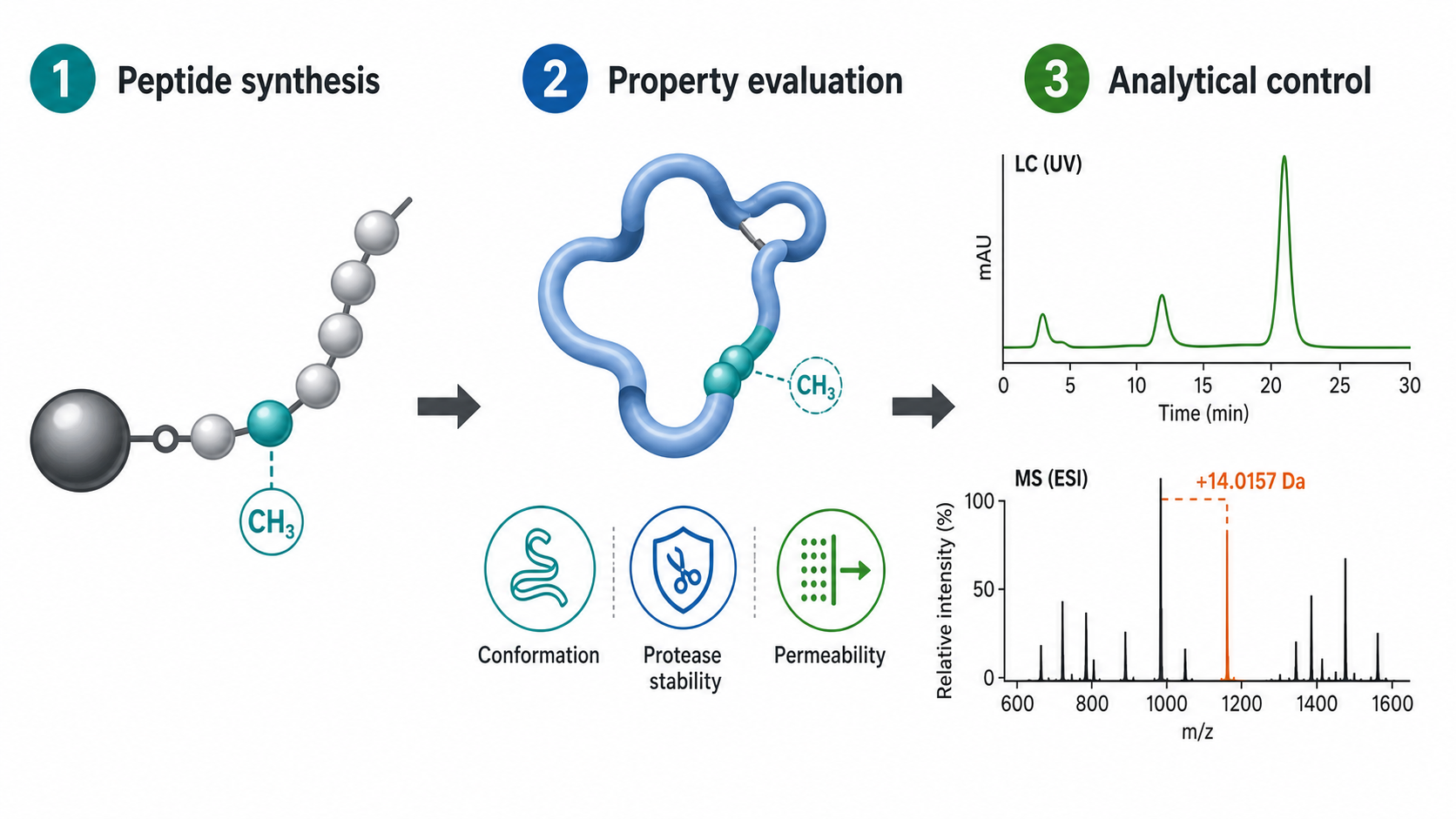
Use of methylated amino acids in peptide synthesis, property evaluation, and analytical control
Proteases recognize both amino acid side chains and peptide-backbone geometry. N-methylation can interfere with substrate recognition by removing a backbone hydrogen-bond donor and introducing steric hindrance.
α-Methyl amino acids may also reduce cleavage by restricting the conformation required for enzyme binding.
The degree of protection depends on the methylation position and the protease involved. One modified residue may substantially improve stability, while another position in the same peptide may have little effect.
N-methyl and α-methyl amino acids can restrict the number of conformations available to a peptide. This may help stabilize a target-binding conformation and reduce the entropic cost of binding.
Backbone N-methylation can also affect the cis-trans equilibrium of adjacent peptide bonds. This may be useful in selected cyclic peptides but can also produce multiple slowly interconverting conformers.
NMR, chromatography, and computational analysis may be needed to determine whether the intended conformation has actually been achieved.
Peptides often have low passive membrane permeability because of their size, polarity, exposed hydrogen-bond donors, and conformational flexibility.
N-methylation can mask selected backbone hydrogen-bond donors. In an appropriately designed cyclic peptide, this may support improved passive permeability.
The effect is not determined by the number of N-methyl groups alone. Solubility, charge, three-dimensional conformation, intramolecular hydrogen bonding, and exposed polar surface area must also be considered.
Methylated amino acids can be combined with other peptide optimization strategies, including:
These approaches should be evaluated as an integrated design rather than as independent modifications.
Protected methylated amino acids can be incorporated through solid-phase peptide synthesis. Fmoc-based synthesis is commonly used, although the appropriate route depends on the residue, protecting groups, and sequence.
N-methyl amino acids are more sterically hindered than conventional amino acids. Difficulties may occur when coupling an amino acid to an N-methylated residue or extending the chain after that residue.
Potential process issues include:
Possible responses include longer coupling times, double coupling, alternative activation systems, lower resin loading, and reaction monitoring. More aggressive conditions should not be applied automatically because they may increase side reactions.
Direct on-resin N-methylation is possible in selected synthetic routes, but chemoselectivity, protecting-group compatibility, and conversion must be demonstrated. Preformed methylated building blocks often provide more predictable positional control.
The monoisotopic mass added by one methyl group is approximately 14.01565 Da. High-resolution mass spectrometry can support molecular-formula confirmation and identify unmethylated or overmethylated impurities.
A 14.01565 Da shift does not establish the modification site. It can also be confused with other mass differences if the measurement lacks sufficient resolution or fragmentation evidence.
MS/MS can localize methylation when diagnostic fragment ions cover the modified region. Interpretation becomes more difficult when several possible methylation sites are located close together.
Symmetric and asymmetric dimethylarginine have the same precursor mass. Distinguishing them may require diagnostic fragmentation, optimized chromatography, derivatization, or comparison with synthetic standards.
Reversed-phase HPLC or UPLC is commonly used to assess purity and monitor process-related impurities. Methylation may alter retention time by changing hydrophobicity and conformation.
Multiple chromatographic peaks do not always indicate different chemical identities. N-methylated peptides can form conformers that interconvert slowly on the chromatographic timescale.
NMR can provide information about methylation position, stereochemistry, conformation, and peptide-bond configuration. It is particularly useful when isomers cannot be distinguished conclusively by intact mass.
For α-methyl amino acids, chiral chromatography or validated stereochemical methods may be needed to confirm configuration and enantiomeric purity.
A purity percentage alone is not enough to assess whether a methylated amino acid is suitable for a project. Researchers should consider:
For protected building blocks, the identity and position of each protecting group should be stated clearly. For methylated peptides, the sequence, modification site, termini, salt form, and purity method should be defined before synthesis.
Methylated amino acids and peptides are commonly used as:
For antibody studies, specificity should be tested against the unmethylated peptide, alternative methylation states, and sequence-related controls. Recognition of a free methylated amino acid does not prove recognition of the same residue within a protein.
Reversibility is well supported for many lysine methylation events, but it should not be generalized to every residue or biological context.
Intact mass can confirm the number of added methyl groups but usually cannot determine their positions.
A permeability benefit is sequence- and conformation-dependent. N-methylation may also reduce solubility or target affinity.
α-Methyl amino acids may introduce additional stereochemical requirements. An incorrect configuration can produce a peptide with very different activity and conformation.
Purity results depend on the analytical method, wavelength, column, gradient, and impurity response. HPLC area purity should not be treated as a complete measure of chemical quality.
Lysine and arginine are the most extensively characterized. Histidine methylation is also biologically relevant, while methylation of other residues and terminal groups occurs in more specialized settings.
Some are produced naturally by methyltransferases. Others are synthesized as peptide building blocks, analytical standards, or chemical probes.
Methyllysine usually refers to methylation of the lysine side-chain ε-amino group. An N-methyl amino acid used in peptide design normally contains a methyl group on the peptide-backbone nitrogen.
Selected N-methyl and α-methyl residues can improve resistance to proteolysis. The result depends on the modification position, peptide sequence, conformation, and enzyme involved.
Site confirmation may require tandem mass spectrometry, NMR, peptide mapping, chromatographic separation, and comparison with a synthetic reference standard.
Methylated amino acids include several structurally and functionally distinct groups. Side-chain methylation of lysine, arginine, and histidine plays important roles in protein regulation, while synthetic N-methyl and α-methyl amino acids are valuable tools for peptide design.
A single methyl group can influence molecular recognition, conformation, protease susceptibility, permeability, and analytical behavior. These effects are highly position-dependent. Reliable research therefore requires precise structural definition, appropriate synthesis methods, and orthogonal analytical confirmation.